
IPv4 Prices in 2026: What Changed and Whether to Lease or Buy
Xantho team · 19 October 2026 · 10 min read
IPv4 addresses ran out years ago, but the market for them keeps moving. Prices peaked at about $60 per address in late 2021 and have been falling since, with average deal prices down 35.7% year on year by mid-2026 (IPRegistry). For anyone who needs addresses, the question is no longer only "how much does an IPv4 address cost?" It is whether to tie up capital in a falling asset or lease what you need.
This guide breaks down 12 months of IPv4 transaction prices by block size, region and quarter, then compares the real cost of leasing and buying.
IPv4 prices in 2026: the numbers
We looked at every priced sale published by IPv4.Global, one of the largest IPv4 brokers and marketplaces, from 20 October 2025 to 17 October 2026. These figures cover IPv4.Global sales only, not every IPv4 transfer in the market, so read them as a large sample of market prices rather than a full count. Here is what that sample shows.
| Metric | Figure |
|---|---|
| Priced transfers | 1,078 |
| Addresses transferred | 7.65 million |
| Total deal value | $96.5 million |
| Median price per IP (all deals) | $20.50 |
| Volume-weighted average price per IP | $12.62 |
| Cheapest deal | $8.50 per IP (ARIN /15, January 2026) |
| Most expensive deal | $41.00 per IP (ARIN /24, three deals) |
Source: Xantho analysis of IPv4.Global published sales, 20 October 2025 to 17 October 2026. Private sales and other brokers' deals are not included.
The gap between the median ($20.50) and the volume-weighted average ($12.62) tells the main story of 2026. Most deals are small blocks at $18–$26 per IP, but most addresses move in a few very large blocks at $9–$14.
The IPv4.Global figures line up with wider market reports. IPRegistry, which tracks priced deals across several brokers, counted 596 priced deals in H1 2026 at an average of $20.04 per address and a median of $20.00, with 29.7 million addresses transferred across all registries in that half-year (IPRegistry).
Price per IP by quarter
| Quarter | Deals | Median price per IP |
|---|---|---|
| Q4 2025 (from 20 Oct) | 202 | $22.00 |
| Q1 2026 | 281 | $20.50 |
| Q2 2026 | 260 | $19.25 |
| Q3 2026 | 279 | $19.00 |
| Q4 2026 (to 17 Oct) | 56 | $21.00 |
Prices slid for three quarters in a row, then firmed in early autumn. It is too soon to call a recovery from 56 deals, but IPv4.Global's September 2026 market report also shows large-block prices recovering from their spring lows.
How IPv4 prices changed by block size
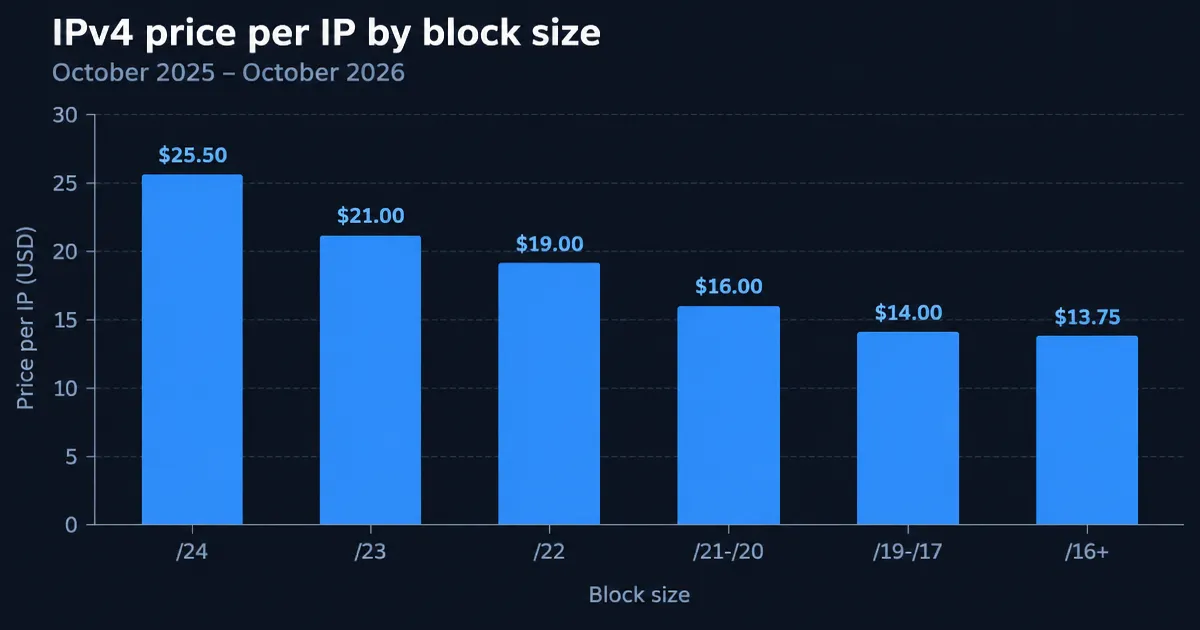
Block size matters more than anything else in IPv4 pricing. Small blocks are scarce and in demand from hosting companies, VPN providers and growing networks. Large blocks have few buyers who can pay six or seven figures at once.
| Block | Addresses | Median, Oct–Dec 2025 | Median, mid-Jul–Oct 2026 | Change |
|---|---|---|---|---|
| /24 | 256 | $26.67 | $25.50 | −4% |
| /23 | 512 | $22.47 | $21.00 | −7% |
| /22 | 1,024 | $22.00 | $19.00 | −14% |
| /21–/20 | 2,048–4,096 | $20.00 | $16.00 | −20% |
| /19–/17 | 8,192–32,768 | $17.50 | $14.00 | −20% |
| /16 and larger | 65,536+ | $13.00 | $13.75* | — |
*Only four /16-or-larger deals in the later period, so treat this figure as indicative.
Small blocks: stable at about $25 per IP
The /24 is the most traded block in the market, with 319 IPv4.Global sales in the period. Its median price dipped to about $23 in January and February 2026, then recovered to $25.00–$26.50 from May onwards. A /24 cost about $6,500 in October 2026, close to where it was a year earlier.
Mid-size and large blocks: down 14–20%
Blocks from /22 to /17 took the biggest hit. A /22 lost 14% of its per-IP value; /20 to /17 blocks lost about 20%. The lowest point came on 31 March 2026, when eight ARIN blocks from /20 to /18 sold at $9.00 per IP. In October 2026, a batch of thirteen LACNIC /20 and /21 blocks sold at $13.00 per IP, a sign that large sellers are still willing to discount for a quick sale.
The small-block premium has widened
In late 2025 a /24 cost 52% more per address than a /17–/19 block. By autumn 2026 the premium had grown to 82%. If you only need a few hundred addresses, you are paying the top of the market, whether you buy or lease.
IPv4 prices by region
ARIN (North America) blocks made up 51% of deals and 65% of addresses in the IPv4.Global sales, followed by RIPE (Europe, Middle East and Central Asia) with 41% of deals. APNIC and LACNIC together accounted for 8%.
For the block sizes most businesses buy, regional prices are now close. In Q3 2026 the median /24 sold for $25.50 per IP in ARIN and $25.85 in RIPE; a /22 sold for $17.65 in ARIN and $19.35 in RIPE. RIPE /22s have held their value slightly better, which matches the steady demand from European hosting and cloud providers.
Why IPv4 prices are moving
- More supply from large holders. Companies that moved internal networks to IPv6 or consolidated after mergers are selling surplus blocks, which pushes down large-block prices.
- IPv6 adoption reduces long-term demand. More than half of Google's users reached it over IPv6 for the first time on 28 March 2026 (Internet Society). Buyers expect less IPv4 dependence over time and pay less for long-term ownership.
- Small blocks stay in demand. Hosting, VPN, email and SaaS providers still need clean, routable IPv4 to reach every customer. About 46% of website hosts were still IPv4-only in August 2026 (Internet Society).
- Cloud providers charge for IPv4. AWS charges $0.005 per hour for every public IPv4 address, about $43.80 per address per year (Tom's Hardware). That makes bringing your own addresses, bought or leased, more attractive for cloud-heavy companies.
Leasing vs buying IPv4: the real cost
The purchase price is only part of the cost of owning IPv4. You also pay registry fees every year, transfer fees, and carry the risk that the block is worth less when you sell it.
Calculator
IPv4 lease vs buy calculator
Compare the full cost of leasing IPv4 addresses with buying them, including registry fees and what you get back if you sell. Defaults use the figures from this analysis; change any value.
Leasing costs less
$2,893 less over 36 months
Before any resale, leasing stays cheaper for at least 20 years. Buying needs $9,608 up front; leasing needs $115 in the first month.
Lease
$4,147
- 256 IPs × $0.45 × 36 mo
- $4,147
- Per month
- $115.20
Buy
$7,040
- 256 IPs × $25.50
- $6,528
- One-time fees
- $1,100
- Yearly fees × 3
- $5,940
- Resale
- −$6,528
- Net cost
- $7,040
Cumulative cost over the term
months
Purchase prices are medians from IPv4.Global published sales, 20 July – 17 October 2026. Registry fees are 2026 figures from the ARIN fee schedule and RIPE NCC charging scheme; ARIN yearly fees above a /22 are estimates. Yearly fees are counted at the start of each year. This is an estimate, not a quote.
What it costs to own IPv4
- ARIN: The recipient pays a transfer processing fee of $187.50 for a /24 or $375 for a block up to /22, plus an annual Registration Services Plan fee of $275 for a /24 or $550 for up to a /22 (ARIN).
- RIPE NCC: To hold IPv4 in the RIPE region you need an LIR account, with a €1,000 sign-up fee and a €1,800 annual fee in 2026 (RIPE NCC). For a single /24, that annual fee alone is more than leasing the block.
- Your time. Buying means checking the block's history, escrow, registry paperwork and setting up RPKI, route objects and reverse DNS yourself.
What it costs to lease IPv4
Lease rates for clean RIPE and ARIN space ran at about $0.38–$0.59 per IP per month in 2026 (IPRegistry). At $0.45 per IP, a /24 costs about $115 per month. A lease usually includes the Letter of Authorisation (LOA), route objects, RPKI ROA, reverse DNS and geolocation setup.
A /24 over three and five years
The example below compares buying a /24 at the October 2026 median of $25.50 per IP with leasing at $0.45 per IP per month.
| Lease | Buy (ARIN member) | Buy (new RIPE LIR) | |
|---|---|---|---|
| Upfront cost | $0 | $6,528 + $187.50 fee | $6,528 + €1,000 sign-up |
| Yearly cost | $1,382 | $275 | €1,800 |
| Total paid over 3 years | $4,147 | $7,541 | $6,528 + €6,400 |
| Total paid over 5 years | $6,912 | $8,091 | $6,528 + €10,000 |
| Price risk | None | Resale value can fall | Resale value can fall |
If you resell the block at the end, ownership gets cheaper. An ARIN buyer who sells after three years at today's price recovers $6,528, for a net cost of about $1,000 plus broker fees. If the price falls 20%, as mid-size blocks did this year, the net cost rises to about $2,300. The figures in this example are rounded and before any broker commission.
When leasing makes more sense
- You need a /24 to a /22, and you are not already an LIR or ARIN member.
- Your horizon is under about five years, or you expect IPv6 to cut your IPv4 needs.
- You want to scale up or down without selling blocks.
- You would rather keep capital in your business than in an asset that lost up to 20% in a year.
- You want routing, RPKI and reputation handled by the provider.
When buying makes more sense
- You already pay LIR or ARIN membership fees, so extra address space costs little to hold.
- You need large blocks (/20 or bigger) for many years. At $14–$16 per IP, buying a /20 costs about $57,000–$66,000, and lease savings can pay that back in three to four years.
- You want the addresses on your balance sheet and can accept that their resale value may go up or down.
How to choose an IPv4 lease
- Clean history. Ask for the block's previous use and check it against major blocklists before you announce it.
- Correct registry setup. The provider should create the route object, RPKI ROA and reverse DNS for you, and give you an LOA for your upstream providers.
- Geolocation. Make sure the block maps to the country where you operate; a wrong location causes problems with streaming, banking and ad platforms.
- Contract terms. Check the minimum term, notice period and how prices change at renewal.
- IPv6 as well. If you plan a dual-stack network, one provider for IPv4 and IPv6 means one contract and one support contact. Our guide to IPv6 adoption in business explains how to plan the transition.
Xantho leases clean IPv4 space with full routing setup included. See our IPv4 leasing options.
Conclusion: IPv4 is cheaper, but ownership is not always the cheaper choice
IPv4 prices fell through most of 2026, especially for mid-size and large blocks, and small blocks stayed expensive at about $25 per IP. Lower prices make buying look tempting, but registry fees, setup work and resale risk change the maths. For most businesses that need up to a /22 for the next few years, leasing is the lower-cost and lower-risk option. Buying pays off for large, long-term holdings and for organisations that are already registry members.
Xantho helps businesses get the IPv4 and IPv6 resources they need. Contact our team to compare a lease with the cost of buying for your network.
Frequently asked questions about IPv4 prices
How much does an IPv4 address cost in 2026?
Across 1,078 IPv4.Global marketplace sales from October 2025 to October 2026, the median price was $20.50 per IP. Small /24 blocks sold for about $25.50 per IP, while blocks of /17 and larger sold for $11–$14 per IP.
Are IPv4 prices going down?
Mostly, yes. The median deal price fell from $22.00 in Q4 2025 to $19.00 in Q3 2026, and mid-size blocks lost about 20% of their per-IP value. Small /24 blocks held steady, and prices firmed slightly in early Q4 2026.
How much does it cost to lease IPv4 addresses?
Lease rates for clean RIPE and ARIN space ran at about $0.38–$0.59 per IP per month in 2026. A /24 (256 addresses) costs roughly $100–$150 per month, usually with LOA, RPKI and reverse DNS setup included.
Is it better to lease or buy IPv4?
Leasing usually costs less if you need a /24 to a /22 for under five years and are not already a registry member, because LIR or ARIN fees and resale risk add to the purchase price. Buying makes more sense for large blocks held for many years.
What fees do you pay when buying IPv4?
In the ARIN region, the recipient pays a transfer fee of $187.50 for a /24 and an annual fee of $275. In the RIPE region, you need an LIR account with a €1,000 sign-up fee and a €1,800 annual fee in 2026. Broker commissions are extra.