
IPv6 Adoption in Business: Why 2026 Is the Tipping Point
Xantho team · 2 October 2026 · 9 min read
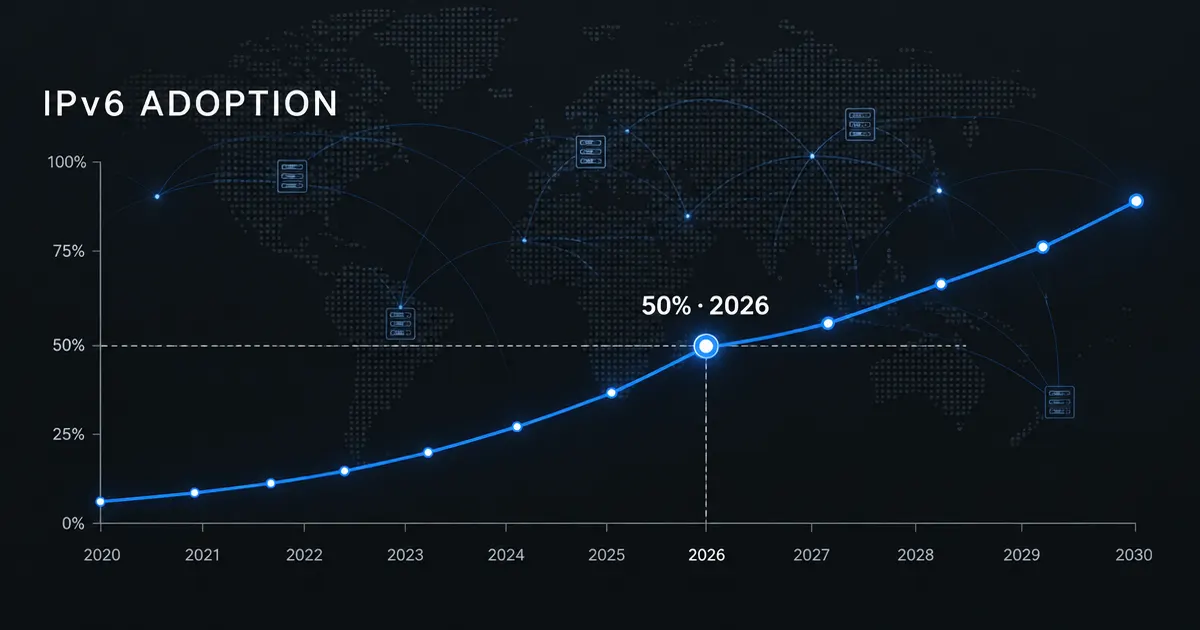
For almost three decades, IPv6 was the protocol everyone agreed on and few deployed. 2026 changed that. On 28 March 2026, native IPv6 access to Google passed 50% for the first time, reaching 50.10% (Internet Society Pulse). IPv6 adoption is no longer a question of "if" for businesses. It is a question of how fast, and how to run both protocols while the rest of the internet catches up.
This article covers the latest IPv6 adoption statistics, which industries are leading, what is driving the shift, and a practical roadmap for IPv6 implementation in your own network.
IPv6 adoption statistics in 2026
Global IPv6 adoption has crossed the halfway mark, but it is uneven across countries, networks and days of the week.
| Metric | Figure | Source |
|---|---|---|
| Google users on native IPv6 | 50.10% (28 March 2026) | Internet Society |
| Google users on IPv6, early 2025 | About 43% | Wikipedia: IPv6 deployment |
| HTTP traffic over IPv6 seen by Akamai, Cloudflare and Google | About 40–45% | Netmeister, Feb 2026 |
| Website hosts that are dual-stack (IPv4 + IPv6) | 54.27% of 5.3 million hosts (Aug 2026) | Internet Society |
| RIPE NCC member accounts (LIRs) holding IPv6 | 15,735 of 20,782 (June 2026) | RIPE NCC |
Adoption varies sharply by country
Country-level IPv6 adoption ranges from more than 70% to single digits. France (73%), India (72%) and Saudi Arabia (65%) lead, while Italy (17%), Spain (10%) and Egypt (4%) trail (Internet Society). If your customers are spread across markets, your IPv6 traffic share will reflect where they are.
The business network gap
Google's IPv6 share swings between roughly 45% and 50% depending on the day, and it is higher at weekends (Wikipedia). Analysts read the weekday dip as a sign that home and mobile networks support IPv6 more often than office networks do (Netmeister). In short: your customers are probably already on IPv6. Your corporate network may not be.
Why businesses are accelerating IPv6 implementation
Six forces are moving IPv6 from a long-term idea to a current budget line.
1. IPv4 addresses cost real money
The free pool of IPv4 addresses is gone, so every additional address is bought, leased or rented from a provider or you have to join waiting lists in RIPE, ARIN and wait for IPv4 for 1-2 years. Since 1 February 2024, AWS charges $0.005 per hour for every public IPv4 address, about $43.80 per address per year. On the open market, an August 2026 report recorded an average transaction price of $20.30 per IPv4 address, with lease rates of roughly $0.30–$0.50 per IP per month (market summary).
2. Even private IPv4 space runs out
Large organisations hit limits inside their own networks too. Microsoft's IT team reported that it had used up almost all private (RFC 1918) IPv4 space, which forced awkward NAT designs between its corporate network, Azure and acquired companies (APNIC Blog). Running dual-stack everywhere also doubles network design and troubleshooting effort, which is why Microsoft set an IPv6-only goal (Internet Society).
3. Government mandates shape procurement
The US Office of Management and Budget memo M-21-07 required at least 80% of IP-enabled assets on federal networks to run IPv6-only by fiscal year 2025 (HSToday). Progress has been slower than planned: by October 2025, no agency had publicly announced reaching that target. Mandates like this still matter for vendors, because agencies must buy IT that is IPv6-capable (FedScoop). In Europe, many public and private buyers use the RIPE-554 document to specify IPv6 requirements for ICT equipment.
4. Mobile and 5G networks are IPv6-first
Mobile operators adopted IPv6 early because subscriber growth outran IPv4 supply. Operators that move to IPv6-only report that 70–95% of their traffic becomes IPv6 (Internet Society). T-Mobile US runs IPv6-only to handsets and uses 464XLAT so IPv4-only apps keep working (Internet Society). For any business with a mobile audience, a large share of visitors already arrives over IPv6.
5. IoT needs addresses at scale
IPv6 offers about 3.4×10^38 addresses, enough for every sensor, meter and machine to have its own (RIPE Labs). Device support is the catch: in one test, only 8.6% of IoT devices kept working on an IPv6-only network (SixMap). New devices are increasingly designed IPv6-first, but most industrial estates will be mixed for years.
6. Cloud, CDN and hosting providers enable it by default
Much recent website progress comes from a small number of hosting, cloud, DNS, CDN and email providers switching IPv6 on by default (Internet Society). Many companies now have IPv6 on their public site without having planned it, which makes it important to test and secure what is already live.
IPv6 adoption by industry
The sectors furthest ahead are those where IPv4 scarcity hurt first or where regulation set deadlines.
| Industry | Where it stands | Main driver | Typical approach |
|---|---|---|---|
| Mobile operators | IPv6-majority on many networks | Subscriber growth, IPv4 scarcity | IPv6-only with 464XLAT or NAT64 |
| Cloud and hosting | IPv6 widely available, often on by default | Per-address IPv4 costs | Dual-stack networks, IPv6-only subnets |
| SaaS, media and e-commerce | Public sites often dual-stack via CDN | Reaching mobile users natively | Dual-stack edge, IPv4 kept for reachability |
| Government and public sector | Targets set, delivery behind schedule | Mandates and procurement rules | IPv6-only targets, IPv6 in tenders |
| Corporate IT | Mostly dual-stack, IPv6-only pilots | Private IPv4 exhaustion, mergers | Guest Wi-Fi or lab pilots first |
| Manufacturing and IoT | Mixed estates, growing IPv6 device base | Address scale | Segmented dual-stack networks |
The IPv6 lease market: how it works and what it costs
IPv4 is leased because it is scarce; IPv6 is leased for independence. The block your ISP or cloud provider gives you belongs to them — change providers and you renumber every server, firewall rule and DNS record. A leased block is announced over BGP from any data centre, cloud or ISP that accepts customer prefixes, so your addresses move with you.
The alternatives are heavier. Running your own RIPE NCC membership means annual LIR fees and administration, while provider-independent (PI) space needs a sponsoring LIR and RIPE policy forbids sub-assigning PI to other organisations (RIPE NCC) — which rules PI out for hosting providers and MSPs.
| Block | Contains | Typical user |
|---|---|---|
| /48 | 65,536 /64 subnets | A single site or data centre deployment |
| /44 | 16 × /48 | A company with several sites |
| /40 | 256 × /48 | A regional hosting provider or small ISP |
| /32 | 65,536 × /48 | Hosting platforms, ISPs and CDNs |
A /48 is the smallest prefix routed globally, which makes it the entry-level lease (APNIC Blog). A lease usually includes the paperwork that makes routing work: a Letter of Authorisation, a route6 object and an RPKI ROA, an inet6num record in the RIPE Database, reverse DNS delegation and geolocation (geofeed) data.
Prices in 2026 range from about €5 per year for a self-service /48 to €50–90 per month for a fully managed lease, with a /32 typically running €50–200 per month. Even a premium IPv6 lease is cheap per address compared with IPv4, where a single /24 at $0.30–$0.50 per IP per month costs roughly $77–$128 per month — what you pay for is support, a clean prefix and correct registry setup.
When choosing a provider, check their registry standing, ask whether the block has been announced before and check it against blocklists, confirm RPKI ROAs and route objects are included rather than extra, and compare minimum terms and renewal conditions. Xantho leases both IPv4 and IPv6 address space, so a dual-stack network can sit on one contract — see our IPv6 leasing options.
The reality check: dual-stack is the bridge
IPv6 growth does not make IPv4 disappear. In the August 2026 crawl, 45.73% of website hosts were still IPv4-only (Internet Society). Most IPv6 users still run both protocols, and pure IPv6-only setups remain rare outside mobile and data-centre networks (SpeedTestHQ). Even Microsoft 365, which works from IPv6-only devices, needs translation such as DNS64/NAT64 to reach parts of the internet still on IPv4 (Microsoft Learn).
For most businesses, the practical answer is both: IPv6 for growth and lower long-term cost, plus enough IPv4 to stay reachable for every customer and partner. Leasing IPv4 addresses covers the transition period without tying up capital in a shrinking asset, while IPv6 address space lets you build the future network now.
How to implement IPv6 in your business: a 7-step roadmap
Start with what customers touch, prove security parity, then move inward.
- Audit readiness. List routers, firewalls, servers, operating systems, applications, monitoring tools and suppliers, and record IPv6 support for each. Ask your ISP and cloud providers what IPv6 they offer.
- Get address space and plan it. Use provider space from your ISP or apply to RIPE NCC through an LIR. A common practice is a /48 per site and a /64 per subnet, grouped by location and function on 4-bit (nibble) boundaries.
- Dual-stack the edge first. Add AAAA records and enable IPv6 on your website, CDN, load balancers, mail servers (MX), DNS and VPN gateways. This is where most of your IPv6 traffic will come from.
- Match your IPv4 security. Mirror firewall policies for IPv6, do not block all ICMPv6 (it is needed for Neighbor Discovery and path MTU discovery), enable RA Guard and DHCPv6 Guard on access switches, and make sure logs and SIEM tools parse IPv6 addresses.
- Pilot IPv6-only internally. A guest Wi-Fi or lab network with NAT64/DNS64 is a low-risk place to find applications that break. Microsoft began its IPv6-only journey on guest networks for the same reason (Internet Society).
- Measure and monitor. Track the share of traffic on IPv6 and alert on IPv6-specific failures. Browsers fall back to IPv4 quickly (Happy Eyeballs), which can hide broken IPv6 for months.
- Build it into buying and skills. Require IPv6 in every network and software tender, and train your team. RIPE NCC runs IPv6 courses across the region, including an IPv6 Fundamentals course in Vilnius in August 2026 (RIPE NCC).
Conclusion: plan for IPv6, stay reachable on IPv4
IPv6 adoption passed a historic milestone in 2026, and the pressure on businesses will only grow as mobile operators, cloud providers and public buyers move ahead. The winning strategy is not a big-bang switch. It is a phased IPv6 implementation, starting at the edge, with enough IPv4 to serve every customer during the transition.
Xantho helps businesses get the IP resources they need for both sides of that transition. Contact our team to discuss IPv4 leasing or IPv6 address space for your network.
Frequently asked questions about IPv6 adoption
What percentage of the internet uses IPv6 in 2026?
On 28 March 2026, 50.10% of Google's users reached it over native IPv6, the first time the figure passed half. Large CDNs such as Akamai and Cloudflare see roughly 40–45% of HTTP traffic over IPv6, and the share varies widely by country.
Why is IPv6 adoption in business slower than in mobile networks?
Mobile operators faced IPv4 shortages first and could move handsets to IPv6-only with translation. Corporate networks carry older equipment, applications and security tools, so many still run IPv4-only or dual-stack. IPv6 traffic dips on weekdays for this reason.
Does my business still need IPv4 if we deploy IPv6?
Yes, for now. About 46% of website hosts were still IPv4-only in August 2026, and many partners and devices depend on IPv4. Most businesses run dual-stack, adding IPv6 while keeping enough IPv4 to stay reachable.
How much does an IPv4 address cost in 2026?
Prices depend on block size and region. An August 2026 market report put the average purchase price at about $20 per address, with leases around $0.30–$0.50 per IP per month. AWS charges $0.005 per hour for each public IPv4 address.
How long does an IPv6 implementation take?
Dual-stacking public services such as your website, DNS and email can take weeks. Moving internal networks to IPv6-only usually takes months to years, depending on how many applications and devices need upgrading.